Jun Luo, Chen Chen, Shandong Wu
International Conference on Learning Representations (ICLR), 2025
Read research summary and view figure
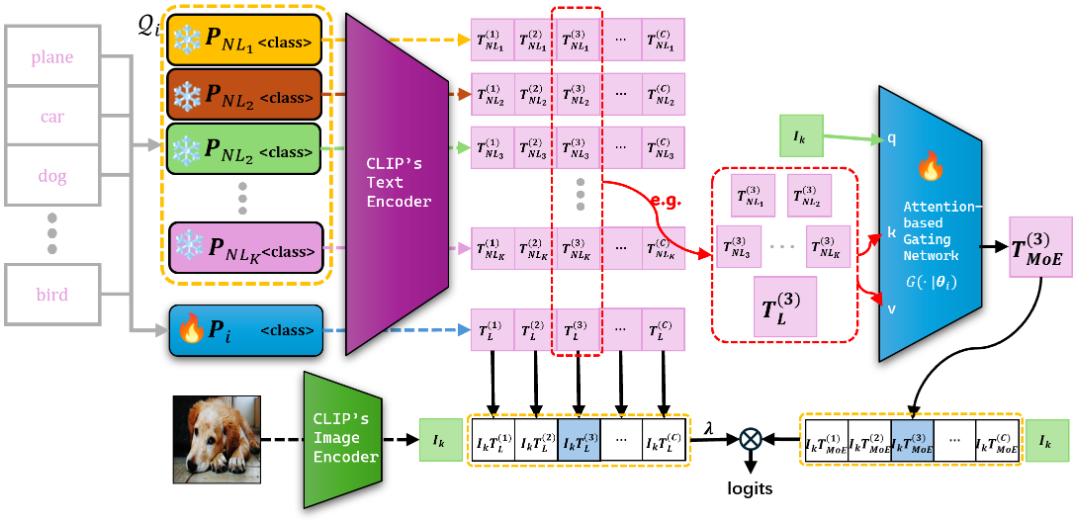
Federated prompt learning benefits federated learning with CLIP-like Vision Language Model’s (VLM’s) robust representation learning ability through prompt learning. However, current federated prompt learning methods are habitually restricted to the traditional FL paradigm, where the participating clients are generally only allowed to download a single globally aggregated model from the server. While justifiable for training full-sized models under federated settings, in this work, we argue that this paradigm is ill-suited for lightweight prompts. By facilitating the clients to download multiple pre-aggregated prompts as fixed nonlocal experts, we propose Personalized Federated Mixture of Adaptive Prompts (pFedMoAP), a novel FL framework that personalizes the prompt learning process through the lens of Mixture of Experts (MoE). pFedMoAP implements a local attention-based gating network that learns to generate enhanced text features for better alignment with local image data, benefiting from both local and downloaded non-local adaptive prompt experts. Extensive experiments on 9 datasets under various federated settings demonstrate the efficacy of the proposed pFedMoAP algorithm.
Matias Mendieta, Guangyu Sun, and Chen Chen
IEEE/CVF Winter Conference on Applications of Computer Vision (WACV), 2025
Read research summary and view figure
Federated learning (FL) enables multiple clients to train models collectively while preserving data privacy. However, FL faces challenges in terms of communication cost and data heterogeneity. One-shot federated learning has emerged as a solution by reducing communication rounds, improving efficiency, and providing better security against eavesdropping attacks. Nevertheless, data heterogeneity remains a significant challenge, impacting performance. This work explores the effectiveness of diffusion models in one-shot FL, demonstrating their applicability in addressing data heterogeneity and improving FL performance. Additionally, we investigate the utility of our diffusion model approach, FedDiff, compared to other one-shot FL methods under differential privacy (DP). Furthermore, to improve generated sample quality under DP settings, we propose a pragmatic Fourier Magnitude Filtering (FMF) method, enhancing the effectiveness of generated data for global model training.

Mahdi Morafah, Vyacheslav Kungurtsev, Hojin Matthew Chang, Chen Chen, Bill Lin
Thirty-eighth Annual Conference on Neural Information Processing Systems (NeurIPS), 2024
Read research summary and view figure
Federated Learning has emerged as a promising paradigm for collaborative machine learning, while preserving user data privacy. Despite its potential, standard FL lacks support for diverse heterogeneous device prototypes, which vary significantly in model and dataset sizes -- from small IoT devices to large workstations. This limitation is only partially addressed by existing knowledge distillation techniques, which often fail to transfer knowledge effectively across a broad spectrum of device prototypes with varied capabilities. This failure primarily stems from two issues: the dilution of informative logits from more capable devices by those from less capable ones, and the use of a single integrated logits as the distillation target across all devices, which neglects their individual learning capacities and and the unique contributions of each. To address these challenges, we introduce TAKFL, a novel KD-based framework that treats the knowledge transfer from each device prototype's ensemble as a separate task, independently distilling each to preserve its unique contributions and avoid dilution. TAKFL also incorporates a KD-based self-regularization technique to mitigate the issues related to the noisy and unsupervised ensemble distillation process. To integrate the separately distilled knowledge, we introduce an adaptive task arithmetic knowledge integration process, allowing each student model to customize the knowledge integration for optimal performance. Additionally, we present theoretical results demonstrating the effectiveness of task arithmetic in transferring knowledge across heterogeneous devices with varying capacities. Comprehensive evaluations of our method across both CV and NLP tasks demonstrate that TAKFL achieves SOTA results in a variety of datasets and settings, significantly outperforming existing KD-based methods.

Guangyu Sun, Matias Mendieta, Aritra Dutta, Xin Li, and Chen Chen
European Conference on Computer Vision (ECCV), 2024
Read research summary and view figure
Multi-modal transformers mark significant progress in different domains, but siloed high-quality data hinders their further improvement. To remedy this, federated learning (FL) has emerged as a promising privacy-preserving paradigm for training models without direct access to the raw data held by different clients. Despite its potential, a considerable research direction regarding the unpaired uni-modal clients and the transformer architecture in FL remains unexplored. To fill this gap, this paper explores a transfer multi-modal federated learning (MFL) scenario within the vision-language domain, where clients possess data of various modalities distributed across different datasets. We systematically evaluate the performance of existing methods when a transformer architecture is utilized and introduce a novel framework called Federated modality complementary and collaboration (FedCola) by addressing the in-modality and cross-modality gaps among clients. Through extensive experiments across various FL settings, FedCola demonstrates superior performance over previous approaches, offering new perspectives on future federated training of multi-modal transformers.

Guangyu Sun, Matias Mendieta, Jun Luo, Shandong Wu, Chen Chen
IEEE/CVF International Conference on Computer Vision (ICCV), 2023
Read research summary and view figure
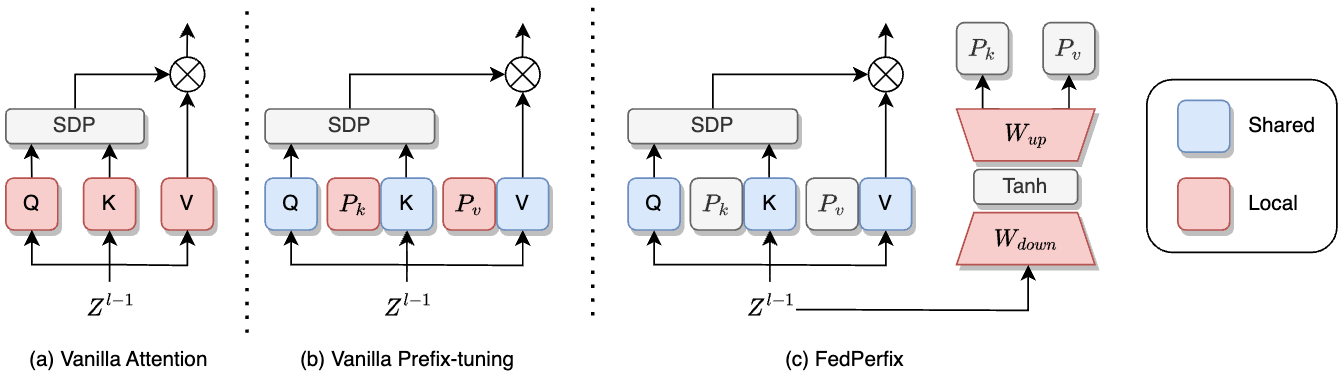
Personalized Federated Learning (PFL) represents a promising solution for decentralized learning in heterogeneous data environments. Partial model personalization has been proposed to improve the efficiency of PFL by selectively updating local model parameters instead of aggregating all of them. However, previous work on partial model personalization has mainly focused on Convolutional Neural Networks (CNNs), leaving a gap in understanding how it can be applied to other popular models such as Vision Transformers (ViTs). In this work, we investigate where and how to partially personalize a ViT model. Specifically, we empirically evaluate the sensitivity to data distribution of each type of layer. Based on the insights that the self-attention layer and the classification head are the most sensitive parts of a ViT, we propose a novel approach called FedPerfix, which leverages plugins to transfer information from the aggregated model to the local client as a personalization. Finally, we evaluate the proposed approach on CIFAR-100, OrganAMNIST, and Office-Home datasets and demonstrate its effectiveness in improving the model's performance compared to several advanced PFL methods.
Matias Mendieta, Taojiannan Yang, Pu Wang, Minwoo Lee, Zhengming Ding, Chen Chen
IEEE Conference on Computer Vision and Pattern Recognition (CVPR), 2022
Read research summary and view figure
Federated learning (FL) is a promising strategy for performing privacy-preserving, distributed learning with a network of clients (i.e., edge devices). However, the data distribution among clients is often non-IID in nature, making efficient optimization difficult. To alleviate this issue, many FL algorithms focus on mitigating the effects of data heterogeneity across clients by introducing a variety of proximal terms, some incurring considerable compute and/or memory overheads, to restrain local updates with respect to the global model. Instead, we consider rethinking solutions to data heterogeneity in FL with a focus on local learning generality rather than proximal restriction. To this end, we first present a systematic study informed by second-order indicators to better understand algorithm effectiveness in FL. Interestingly, we find that standard regularization methods are surprisingly strong performers in mitigating data heterogeneity effects. Based on our findings, we further propose a simple and effective method, FedAlign, to overcome data heterogeneity and the pitfalls of previous methods. FedAlign achieves competitive accuracy with state-of-the-art FL methods across a variety of settings while minimizing computation and memory overhead.