Tianxingjian Ding, Yuanhao Zou, Chen Chen, Mubarak Shah, Yu Tian
European Conference on Computer Vision (ECCV), 2026
Read research summary and view figure
Clinical decision-making in oncology requires predicting dynamic disease evolution, a task current static AI predictors cannot perform. While world models offer a paradigm for generative prediction, existing medical applications often focus on visual reconstruction rather than causal, physiological transitions, and may ignore patient-specific temporal and clinical contexts. We introduce CLARITY, a medical world model that forecasts disease evolution directly within a structured latent space. It integrates time intervals and patient-specific clinical context to model treatment-conditioned progression as a smooth, interpretable trajectory and introduces a prediction-to-decision framework that translates latent rollouts into transparent, actionable recommendations. CLARITY demonstrates state-of-the-art performance in treatment planning and improves over recent medical world model baselines on glioma post-treatment data.

Kai Zhang, Rong Zhou, Eashan Adhikarla, Zhiling Yan, Yixin Liu, Jun Yu, Zhengliang Liu, Xun Chen, Brian Davison, Hui Ren, Jing Huang, Chen Chen, Yuyin Zhou, Sunyang Fu, Wei Liu, Tianming Liu, Xiang Li, Yong Chen, Lifang He, James Zou, Quanzheng Li, Hongfang Liu, Lichao Sun
Nature Medicine, 2024
BiomedGPT • Open-source lightweight biomedical VLM
Read research summary and view figure
Traditional biomedical AI models are often built for specific tasks or modalities and struggle to utilize holistic information. We describe BiomedGPT, an open-source and lightweight vision–language foundation model designed as a generalist capable of performing diverse biomedical tasks. BiomedGPT achieves strong results across a broad set of biomedical experiments while maintaining a computing-friendly scale. Human evaluations further assess radiology visual question answering, report generation, and summarization, demonstrating robust question answering performance, competitive summarization quality, and practical potential for improving diagnosis and workflow efficiency.

Anthony Bilic, Guangyu Sun, Ming Li, Sanzid Hossain, Yu Tian, Wei Zhang, Laura Brattain, Dexter Hadley, Chen Chen
Journal of Medical Imaging, 2025
Read research summary and view figure
Whole Slide Image (WSI) classification commonly relies on Multiple Instance Learning (MIL) over patch features, but existing methods struggle to capture global dependencies due to the local nature of patch embeddings and the immense size of WSIs. We propose Fourier Transform Multiple Instance Learning (FFT-MIL), which adds a frequency-domain branch that extracts compact global context via FFT-derived low-frequency crops and an FFT-Block with normalization to handle high variance. The resulting global feature is fused with spatial patch features through lightweight integration strategies and is compatible with diverse MIL architectures. Across public datasets and multiple MIL baselines, FFT-MIL consistently improves performance, establishing frequency-domain learning as an efficient mechanism for global context in computational pathology.

Wenxuan Wang, Jing Wang, Chen Chen, Jianbo Jiao, Yuanxiu Cai, Shanshan Song, Jiangyun Li
IEEE/CVF Winter Conference on Applications of Computer Vision (WACV), 2024
Read research summary and view figure
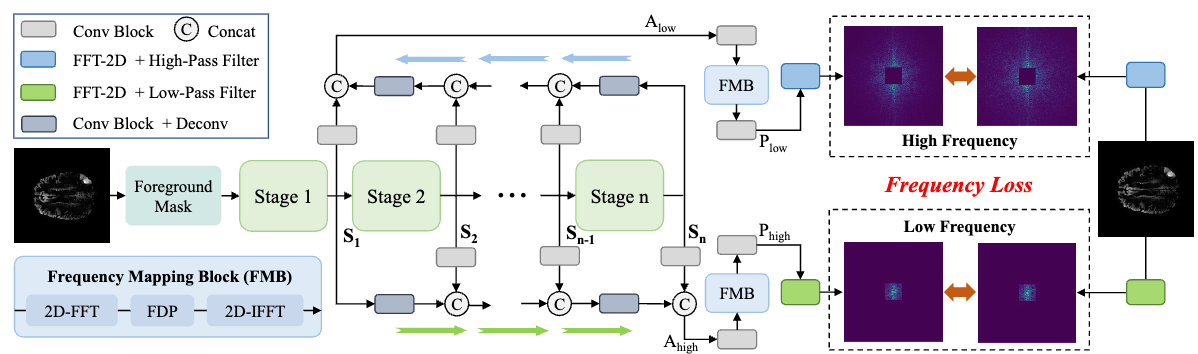
Self-supervised Masked Image Modeling (MIM) has shown strong potential for learning visual representations from unlabeled data. To better capture both global structural information and local details for dense prediction, we propose FreMIM, which incorporates frequency-domain perspectives into MIM for medical image segmentation. Motivated by observations that high-frequency components contain detailed structure and low-frequency components carry higher-level semantics, FreMIM introduces multi-stage supervision during pre-training to guide representation learning. Experiments across benchmark datasets demonstrate consistent improvements over prior MIM methods and strong gains versus training from scratch.
Andong Deng, Taojiannan Yang, Chen Chen, Qian Chen, Leslie Neely, Sakiko Oyama
Smart Health, 2024
Read research summary and view figure
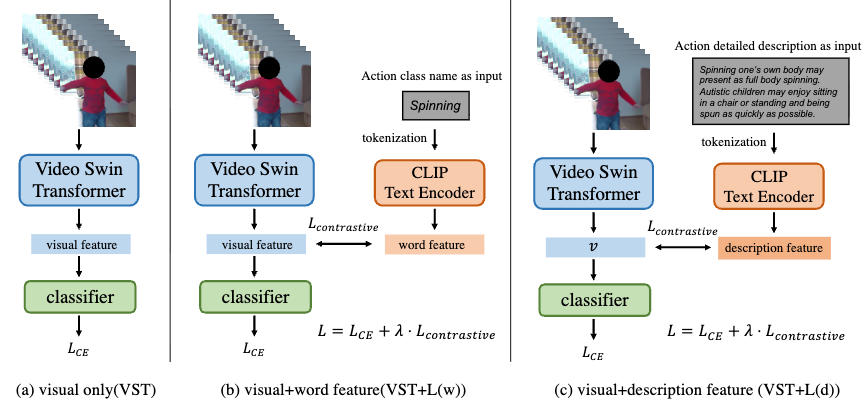
Recognizing behaviors of children with Autism Spectrum Disorder (ASD) is important for diagnosis and early intervention, but human observation can be subjective and inconsistent. We evaluate a strong action recognition baseline (Video Swin Transformer) on autism behavior datasets and demonstrate substantial improvements over prior methods, supporting the feasibility of vision-based ASD behavior recognition. We further propose language-assisted training that incorporates freely available language descriptions of behavior categories in a two-branch multimodal framework. Adding language supervision provides additional performance gains over video-only training on multiple ASD behavior benchmarks.
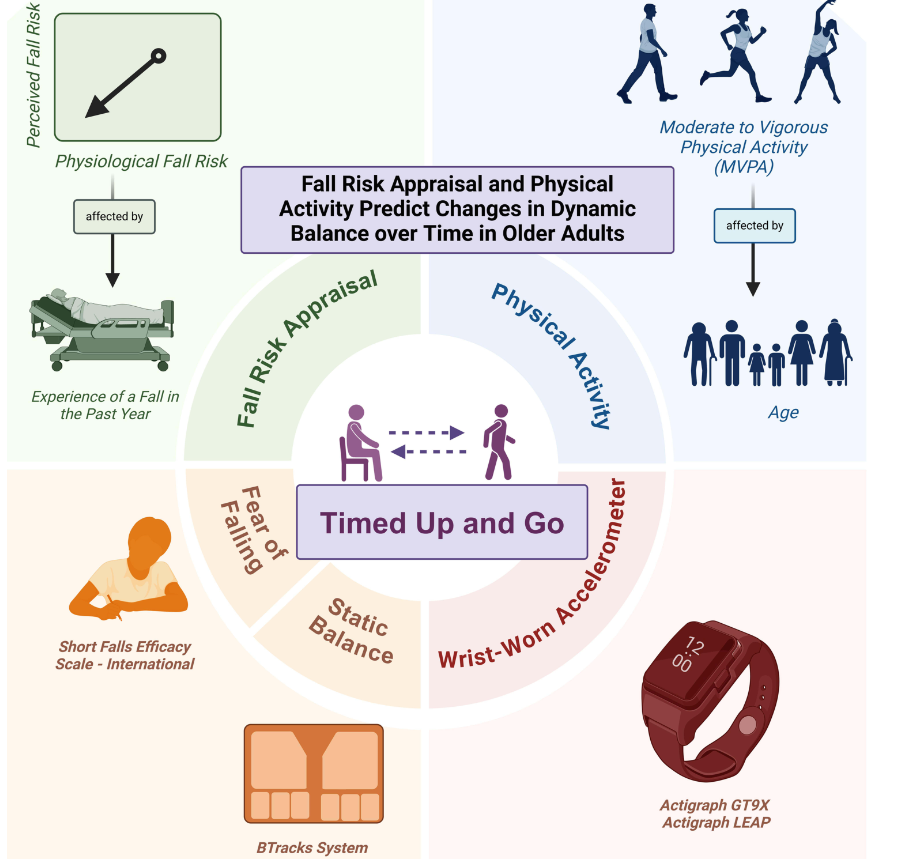
Chitra Banarjee, Jethro Raphael M Suarez, Kworweinski Lafontant, Hwan Choi, Chen Chen, Rui Xie, Ladda Thiamwong
Clinical Interventions in Aging, 2025
Read research summary and view figure
Evaluating changes in dynamic balance is important for understanding fall risk in older adults. This study examines drivers of balance fluctuations over multiple timepoints, including fear of falling, static balance, physical activity, and fall history. Results indicate that several modifiable factors directly influence dynamic balance, while fall history impacts perceived risk relative to actual risk. These findings motivate targeted interventions and inform future multimodal approaches for fall-risk monitoring and prevention.