Kai Zhang, Rong Zhou, Eashan Adhikarla, Zhiling Yan, Yixin Liu, Jun Yu, Zhengliang Liu, Xun Chen, Brian Davison, Hui Ren, Jing Huang, Chen Chen, Yuyin Zhou, Sunyang Fu, Wei Liu, Tianming Liu, Xiang Li, Yong Chen, Lifang He, James Zou, Quanzheng Li, Hongfang Liu, Lichao Sun
Nature Medicine, 2024
Read research summary and view figure
Traditional biomedical artificial intelligence (AI) models, designed for specific tasks or modalities, often exhibit limited flexibility in real-world deployment and struggle to utilize holistic information. Generalist AI holds the potential to address these limitations due to its versatility in interpreting different data types and generating tailored outputs for diverse needs. However, existing biomedical generalist AI solutions are typically heavyweight and closed source to researchers, practitioners and patients. Here, we describe BiomedGPT, the first open-source and lightweight vision–language foundation model, designed as a generalist capable of performing various biomedical tasks. BiomedGPT achieved state-of-the-art results in 16 out of 25 experiments while maintaining a computing-friendly model scale. We also conducted human evaluations to assess the capabilities of BiomedGPT in radiology visual question answering, report generation and summarization. BiomedGPT exhibits robust prediction ability with a low error rate of 3.8% in question answering, satisfactory performance with an error rate of 8.3% in writing complex radiology reports, and competitive summarization ability with a nearly equivalent preference score to human experts. Our method demonstrates that effective training with diverse data can lead to more practical biomedical AI for improving diagnosis and workflow efficiency.

Andong Deng, Zhongpai Gao, Anwesa Choudhuri, Benjamin Planche, Meng Zheng, Bin Wang, Terrence Chen, Chen Chen, Ziyan Wu
IEEE Conference on Computer Vision and Pattern Recognition (CVPR), 2025
Read research summary and view figure
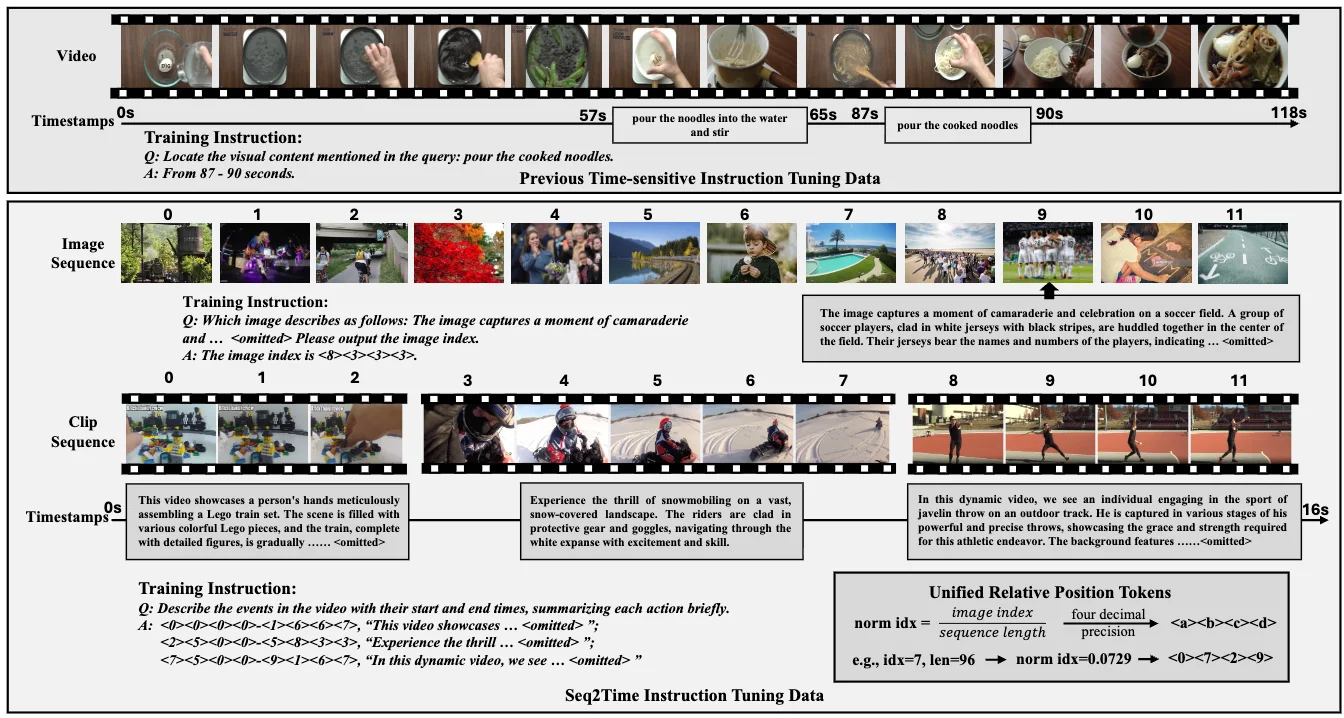
Temporal awareness is essential for video large language models (LLMs) to understand and reason about events within long videos, enabling applications like dense video captioning and temporal video grounding in a unified system. However, the scarcity of long videos with detailed captions and precise temporal annotations limits their temporal awareness. In this paper, we propose Seq2Time, a data-oriented training paradigm that leverages sequences of images and short video clips to enhance temporal awareness in long videos. By converting sequence positions into temporal annotations, we transform large-scale image and clip captioning datasets into sequences that mimic the temporal structure of long videos, enabling self-supervised training with abundant time-sensitive data. To enable sequence-to-time knowledge transfer, we introduce a novel time representation that unifies positional information across image sequences, clip sequences, and long videos. Experiments demonstrate the effectiveness of our method, achieving a 27.6% improvement in F1 score and 44.8% in CIDEr on the YouCook2 benchmark and a 14.7% increase in recall on the Charades-STA benchmark compared to the baseline.
Jing Bi, Junjia Guo, Guangyu Sun, Susan Liang, Luchuan Song, Yolo Y. Tang, Jinxi He, Jiarui Wu, Ali Vosoughi, Chen Chen, Jason J Corso, Chenliang Xu
Conference on Language Modeling (COLM), 2026
Read research summary and view figure
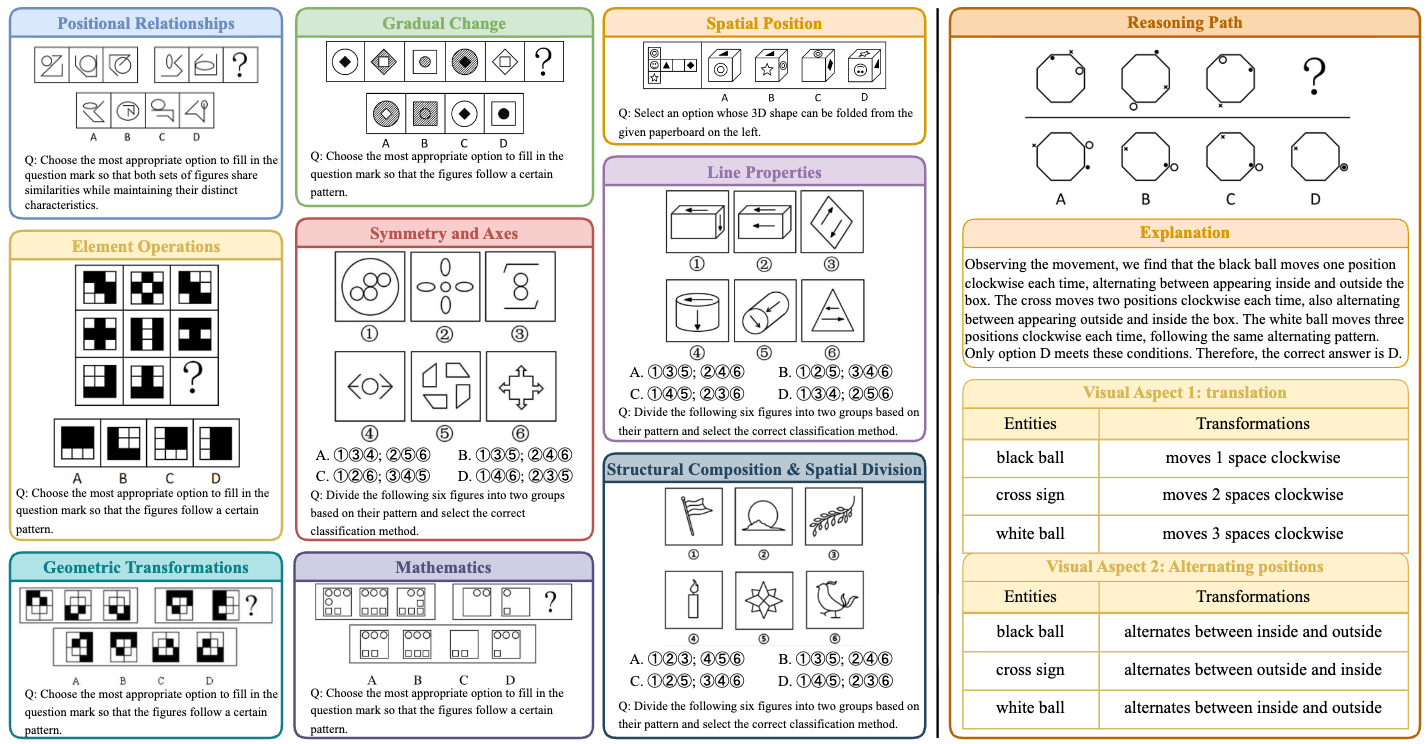
Visual reasoning is central to human cognition, enabling individuals to interpret and abstractly understand their environment. Although recent Multimodal Large Language Models (MLLMs) have demonstrated impressive performance across language and vision-language tasks, existing benchmarks primarily measure recognition-based skills and inadequately assess true visual reasoning capabilities. To bridge this critical gap, we introduce VERIFY, a benchmark explicitly designed to isolate and rigorously evaluate the visual reasoning capabilities of state-of-the-art MLLMs. VERIFY compels models to reason primarily from visual information, providing minimal textual context to reduce reliance on domain-specific knowledge and linguistic biases. Each problem is accompanied by a human-annotated reasoning path, making it the first to provide in-depth evaluation of model decision-making processes. Additionally, we propose novel metrics that assess visual reasoning fidelity beyond mere accuracy, highlighting critical imbalances in current model reasoning patterns. Our comprehensive benchmarking of leading MLLMs uncovers significant limitations, underscoring the need for a balanced and holistic approach to both perception and reasoning.
Jing Bi, Susan Liang, Xiaofei Zhou, Pinxin Liu, Junjia Guo, Yunlong Tang, Luchuan Song, Chao Huang, Guangyu Sun, Jinxi He, Jiarui Wu, Shu Yang, Daoan Zhang, Chen Chen, Lianggong Bruce Wen, Zhang Liu, Jiebo Luo, Chenliang Xu
arXiv:2504.03151
Read research summary and view figure
Reasoning is central to human intelligence, enabling structured problem-solving across diverse tasks. Recent advances in large language models (LLMs) have greatly enhanced their reasoning abilities in arithmetic, commonsense, and symbolic domains. However, effectively extending these capabilities into multimodal contexts-where models must integrate both visual and textual inputs-continues to be a significant challenge. Multimodal reasoning introduces complexities, such as handling conflicting information across modalities, which require models to adopt advanced interpretative strategies. Addressing these challenges involves not only sophisticated algorithms but also robust methodologies for evaluating reasoning accuracy and coherence. This paper offers a concise yet insightful overview of reasoning techniques in both textual and multimodal LLMs. Through a thorough and up-to-date comparison, we clearly formulate core reasoning challenges and opportunities, highlighting practical methods for post-training optimization and test-time inference. Our work provides valuable insights and guidance, bridging theoretical frameworks and practical implementations, and sets clear directions for future research.
