Andong Deng, Taojiannan Yang, Shoubin Yu, Lincoln Spencer, Mohit Bansal, Chen Chen, Serena Yeung-Levy, Xiaohan Wang
Forty-third International Conference on Machine Learning (ICML), 2026
Read research summary and view figure
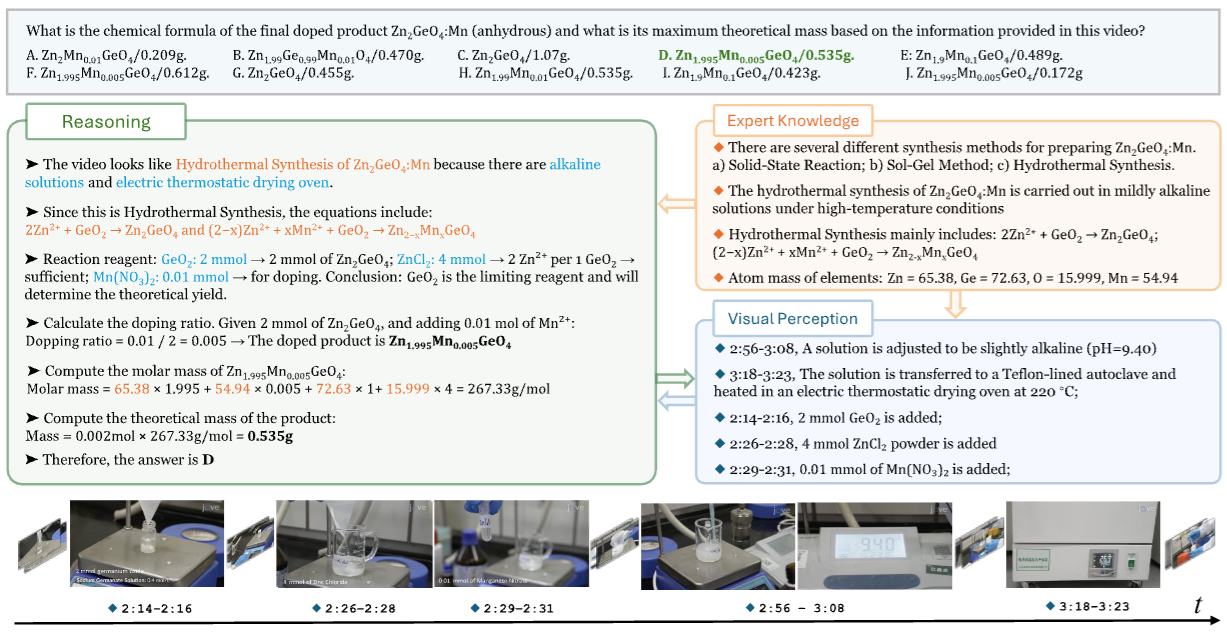
Large Multimodal Models (LMMs) have achieved remarkable progress across various capabilities; however, complex video reasoning in the scientific domain remains a significant and challenging frontier. Current video benchmarks predominantly target general scenarios where perception/recognition is heavily relied on, while with relatively simple reasoning tasks, leading to saturation and thus failing to effectively evaluate advanced multimodal cognitive skills. To address this critical gap, we introduce SciVideoBench, a rigorous benchmark specifically designed to assess advanced video reasoning in scientific contexts. SciVideoBench consists of 1,000 carefully crafted multiple-choice questions derived from cutting-edge scientific experimental videos spanning over 25 specialized academic subjects and verified by a semi-automatic system. Each question demands sophisticated domain-specific knowledge, precise spatiotemporal perception, and intricate logical reasoning, effectively challenging models' higher-order cognitive abilities. Our evaluation highlights significant performance deficits in state-of-the-art proprietary and open-source LMMs, including Gemini 2.5 Pro and Qwen2.5-VL, indicating substantial room for advancement in video reasoning capabilities. Detailed analyses of critical factors such as reasoning complexity and visual grounding provide valuable insights and clear direction for future developments in LMMs, driving the evolution of truly capable multimodal AI co-scientists. We hope SciVideoBench could fit the interests of the community and help to push the boundary of cutting-edge AI for border science.
Yuanhao Zou, Shengji Jin, Andong Deng, Youpeng Zhao, Jun Wang, Chen Chen
The Fourteenth International Conference on Learning Representations (ICLR), 2026
Read research summary and view figure
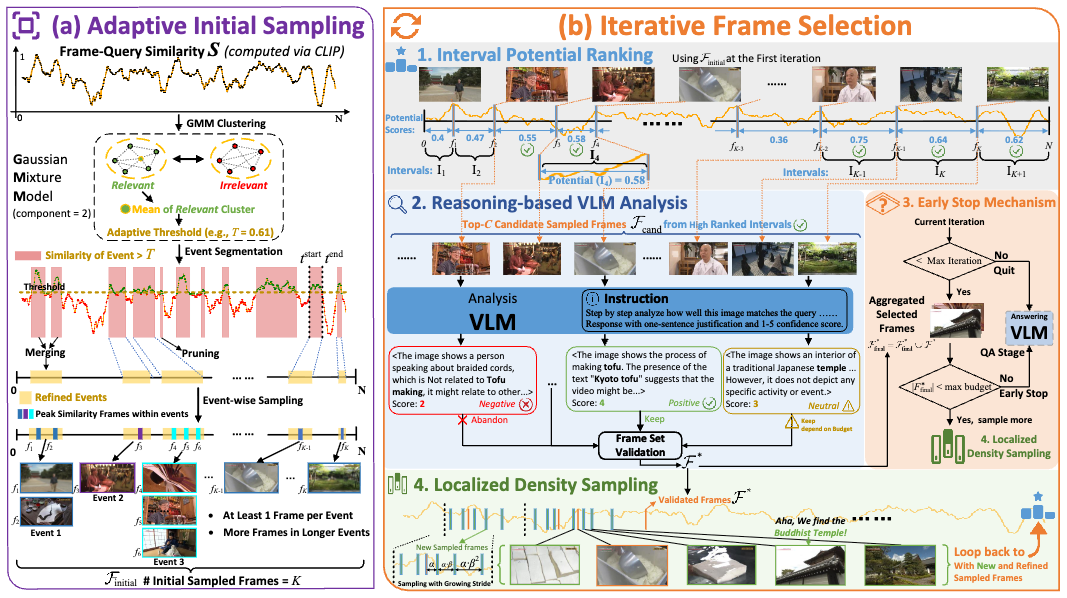
Effectively applying Vision-Language Models (VLMs) to Video Question Answering (VideoQA) hinges on selecting a concise yet comprehensive set of frames, as processing entire videos is computationally infeasible. However, current frame selection methods face a critical trade-off: approaches relying on lightweight similarity models, such as CLIP, often fail to capture the nuances of complex queries, resulting in inaccurate similarity scores that cannot reflect the authentic query-frame relevance, which further undermines frame selection. Meanwhile, methods that leverage a VLM for deeper analysis achieve higher accuracy but incur prohibitive computational costs. To address these limitations, we propose A.I.R., a training-free approach for Adaptive, Iterative, and Reasoning-based frame selection. We leverage a powerful VLM to perform deep, semantic analysis on complex queries, and this analysis is deployed within a cost-effective iterative loop that processes only a small batch of the most high-potential frames at a time. Extensive experiments on various VideoQA benchmarks demonstrate that our approach outperforms existing frame selection methods, significantly boosts the performance of the foundation VLM, and achieves substantial gains in computational efficiency over other VLM-based techniques.
Andong Deng, Tongjia Chen, Shoubin Yu, Taojiannan Yang, Lincoln Spencer, Yapeng Tian, Ajmal Saeed Mian, Mohit Bansal, Chen Chen
IEEE Conference on Computer Vision and Pattern Recognition (CVPR), 2025
Read research summary and view figure
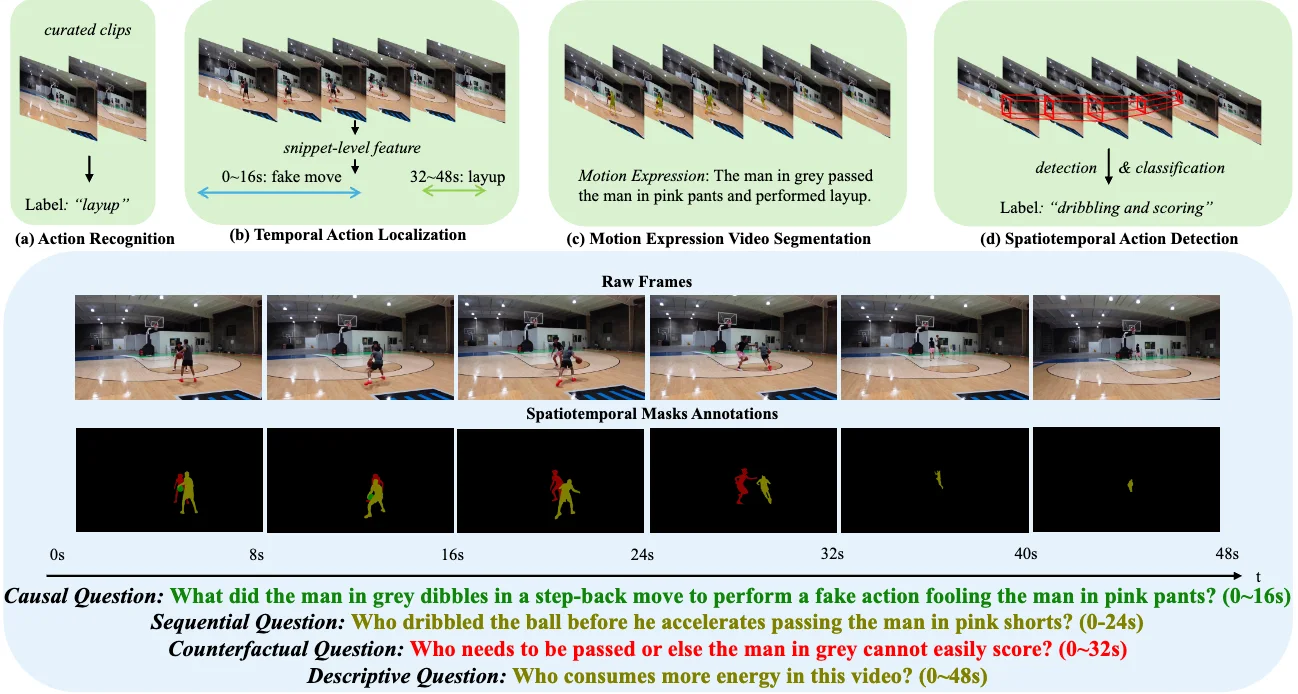
In this paper, we introduce Motion-Grounded Video Reasoning, a new motion understanding task that requires generating visual answers (video segmentation masks) according to the input question, and hence needs implicit spatiotemporal reasoning and grounding. This task extends existing spatiotemporal grounding work focusing on explicit action/motion grounding, to a more general format by enabling implicit reasoning via questions. To facilitate the development of the new task, we collect a large-scale dataset called GROUNDMORE, which comprises 1,715 video clips, 249K object masks that are deliberately designed with 4 question types (Causal, Sequential, Counterfactual, and Descriptive) for benchmarking deep and comprehensive motion reasoning abilities. GROUNDMORE uniquely requires models to generate visual answers, providing a more concrete and visually interpretable response than plain texts. It evaluates models on both spatiotemporal grounding and reasoning, fostering to address complex challenges in motion-related video reasoning, temporal perception, and pixel-level understanding. Furthermore, we introduce a novel baseline model named Motion-Grounded Video Reasoning Assistant (MORA). MORA incorporates the multimodal reasoning ability from the Multimodal LLM, the pixel-level perception capability from the grounding model (SAM), and the temporal perception ability from a lightweight localization head. MORA achieves respectable performance on GROUNDMORE outperforming the best existing visual grounding baseline model by an average of 21.5% relatively. We hope this novel and challenging task will pave the way for future advancements in robust and general motion understanding via video reasoning segmentation
Liyun Zhu, Lei Wang, Arjun Raj, Tom Gedeon, Chen Chen
Thirty-eighth Annual Conference on Neural Information Processing Systems (NeurIPS), 2024
Read research summary and view figure
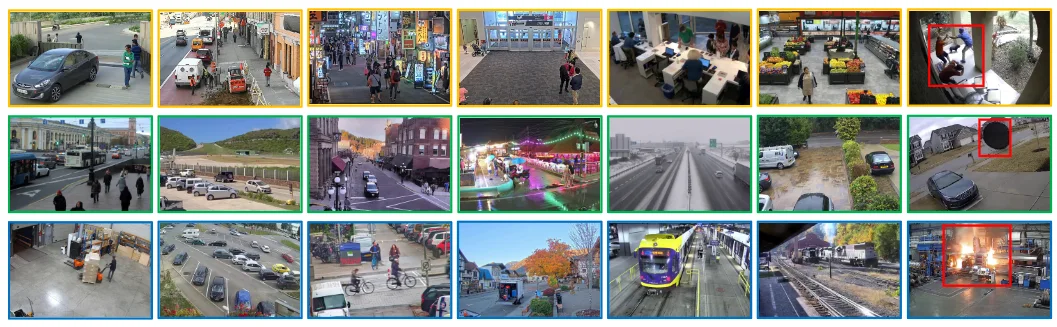
Video Anomaly Detection (VAD) finds widespread applications in security surveillance, traffic monitoring, industrial monitoring, and healthcare. Despite extensive research efforts, there remains a lack of concise reviews that provide insightful guidance for researchers. Such reviews would serve as quick references to grasp current challenges, research trends, and future directions. In this paper, we present such a review, examining models and datasets from various perspectives. We emphasize the critical relationship between model and dataset, where the quality and diversity of datasets profoundly influence model performance, and dataset development adapts to the evolving needs of emerging approaches. Our review identifies practical issues, including the absence of comprehensive datasets with diverse scenarios. To address this, we introduce a new dataset, Multi-Scenario Anomaly Detection (MSAD), comprising 14 distinct scenarios captured from various camera views. Our dataset has diverse motion patterns and challenging variations, such as different lighting and weather conditions, providing a robust foundation for training superior models. We conduct an in-depth analysis of recent representative models using MSAD and highlight its potential in addressing the challenges of detecting anomalies across diverse and evolving surveillance scenarios.
Ishan Rajendrakumar Dave, Chen Chen, Mubarak Shah
IEEE Conference on Computer Vision and Pattern Recognition (CVPR), 2022
Read research summary and view figure
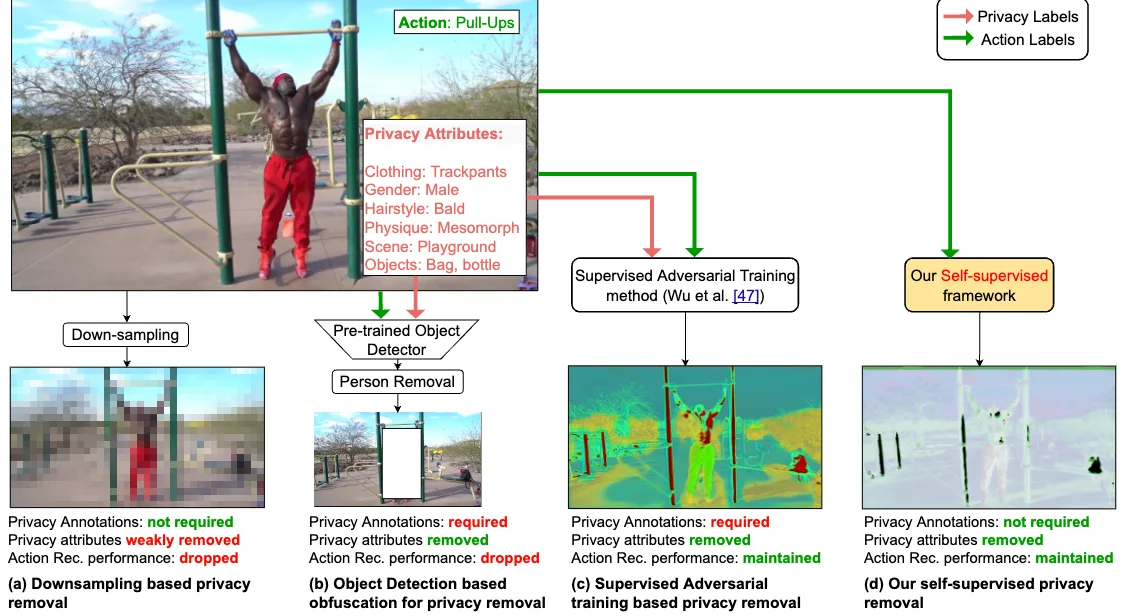
Visual private information leakage is an emerging key issue for the fast growing applications of video understanding like activity recognition. Existing approaches for mitigating privacy leakage in action recognition require privacy labels along with the action labels from the video dataset. However, annotating frames of video dataset for privacy labels is not feasible. Recent developments of self-supervised learning (SSL) have unleashed the untapped potential of the unlabeled data. For the first time, we present a novel training framework which removes privacy information from input video in a self-supervised manner without requiring privacy labels. Our training framework consists of three main components: anonymization function, self-supervised privacy removal branch, and action recognition branch. We train our framework using a minimax optimization strategy to minimize the action recognition cost function and maximize the privacy cost function through a contrastive self-supervised loss. Employing existing protocols of known-action and privacy attributes, our framework achieves a competitive action-privacy trade-off to the existing state-of-the-art supervised methods. In addition, we introduce a new protocol to evaluate the generalization of learned the anonymization function to novel-action and privacy attributes and show that our self-supervised framework outperforms existing supervised methods.
Waqas Sultani, Chen Chen, Mubarak Shah
IEEE Conference on Computer Vision and Pattern Recognition (CVPR), 2018
Read research summary and view figure
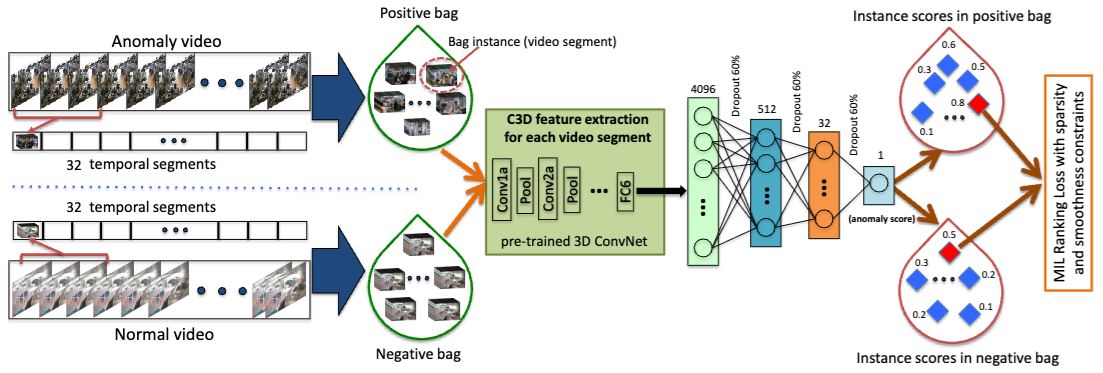
Surveillance videos are able to capture a variety of realistic anomalies. In this paper, we propose to learn anomalies by exploiting both normal and anomalous videos. To avoid annotating the anomalous segments or clips in training videos, which is very time consuming, we propose to learn anomaly through the deep multiple instance ranking framework by leveraging weakly labeled training videos, i.e. the training labels (anomalous or normal) are at video-level instead of clip-level. In our approach, we consider normal and anomalous videos as bags and video segments as instances in multiple instance learning (MIL), and automatically learn a deep anomaly ranking model that predicts high anomaly scores for anomalous video segments. Furthermore, we introduce sparsity and temporal smoothness constraints in the ranking loss function to better localize anomaly during training. We also introduce a new large-scale first of its kind dataset of 128 hours of videos. It consists of 1900 long and untrimmed real-world surveillance videos, with 13 realistic anomalies such as fighting, road accident, burglary, robbery, etc. as well as normal activities. This dataset can be used for two tasks. First, general anomaly detection considering all anomalies in one group and all normal activities in another group. Second, for recognizing each of 13 anomalous activities. Our experimental results show that our MIL method for anomaly detection achieves significant improvement on anomaly detection performance as compared to the state-of-the-art approaches. We provide the results of several recent deep learning baselines on anomalous activity recognition. The low recognition performance of these baselines reveals that our dataset is very challenging and opens more opportunities for future work.