You can access the CRCV Publications Page for enhanced search capabilities.
2020
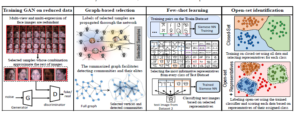
Joneidi, Mohsen; Vahidian, Saeed; Esmaeili, Ashkan; Wang, Weijia; Rahnavard, Nazanin; Lin, Bill; Shah, Mubarak
Select to Better Learn: Fast and Accurate Deep Learning using Data Selection from Nonlinear Manifolds Conference
IEEE Conference on Computer Vision and Pattern Recognition, 2020.
@conference{Jonediei2020,

title = {Select to Better Learn: Fast and Accurate Deep Learning using Data Selection from Nonlinear Manifolds},

author = {Mohsen Joneidi and Saeed Vahidian and Ashkan Esmaeili and Weijia Wang and Nazanin Rahnavard and Bill Lin and Mubarak Shah},

url = {https://www.crcv.ucf.edu/wp-content/uploads/2020/04/Select-to-Better-Learn.pdf

https://www.crcv.ucf.edu/wp-content/uploads/2020/04/Select-to-Better-Learn_Supplementary.pdf},

year  = {2020},

date = {2020-06-14},

publisher = {IEEE Conference on Computer Vision and Pattern Recognition},

abstract = {Finding a small subset of data whose linear combination spans other data points, also called column subset selection problem (CSSP), is an important open problem in computer science with many applications in computer vision and deep learning such as the ones shown in Fig. 1. There are some studies that solve CSSP in a polynomial time complexity w.r.t. the size of the original dataset. A simple and efficient selection algorithm with a linear complexity order, referred to as spectrum pursuit (SP), is proposed that pursuits spectral components of the dataset using available sample points. The proposed non-greedy algorithm aims to iteratively find K data samples whose span is close to that of the first K spectral components of entire data. SP has no parameter to be fine tuned and this desirable property makes it problem-independent. The simplicity of SP enables us to extend the underlying linear model to more complex models such as nonlinear manifolds and graph-based models. The nonlinear extension of SP is introduced as kernel-SP (KSP). The superiority of the proposed algorithms is demonstrated in a wide range of applications.},

keywords = {},

pubstate = {published},

tppubtype = {conference}

}

McIntosh, Bruce; Duarte, Kevin; Rawat, Yogesh Singh; Shah, Mubarak
Visual-textual Capsule Routing for Text-based Video Segmentation Conference
IEEE Conference on Computer Vision and Pattern Recognition (Oral), 2020.
@conference{Duarte2020,

title = {Visual-textual Capsule Routing for Text-based Video Segmentation},

author = {Bruce McIntosh and Kevin Duarte and Yogesh Singh Rawat and Mubarak Shah},

url = {https://www.crcv.ucf.edu/wp-content/uploads/2020/06/Projects_Visual-textual-Capsule-Routing-for-Text-based-Video-Segmentation.pdf

https://www.crcv.ucf.edu/wp-content/uploads/2020/06/Projects_Visual-textual-Capsule-Routing-for-Text-based-Video-Segmentation_Supplementary.zip

https://www.crcv.ucf.edu/research/projects/visual-textual-capsule-routing-for-text-based-video-segmentation/},

year  = {2020},

date = {2020-06-14},

publisher = {IEEE Conference on Computer Vision and Pattern Recognition (Oral)},

edition = {(Oral)},

abstract = {Joint understanding of vision and natural language is a challenging problem with a wide range of applications in artificial intelligence. In this work, we focus on integration of video and text for the task of actor and action video segmentation from a sentence. We propose a capsule-based approach which performs pixel-level localization based on a natural language query describing the actor of interest. We encode both the video and textual input in the form of capsules, which provide a more effective representation in comparison with standard convolution based features. Our novel visual-textual routing mechanism allows for the fusion of video and text capsules to successfully localize the actor and action. The existing works on actor-action localization are mainly focused on localization in a single frame instead of the full video. Different from existing works, we propose to perform the localization on all frames of the video. To validate the potential of the proposed network for actor and action video localization, we extend an existing actor-action dataset (A2D) with annotations for all the frames. The experimental evaluation demonstrates the effectiveness of our capsule network for text selective actor and action localization in videos. The proposed method also improves upon the performance of the existing state-of-the art works on single frame-based localization. },

keywords = {},

pubstate = {published},

tppubtype = {conference}

}
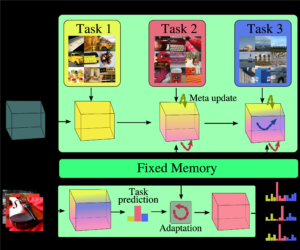
Rajasegaran, Jathushan; Khan, Salman; Hayat, Munawar; Khan, Fahad Shahbaz; Shah, Mubarak
iTAML : An Incremental Task-Agnostic Meta-learning Approach Conference
IEEE Conference on Computer Vision and Pattern Recognition, 2020.
@conference{Khan2020,

title = {iTAML : An Incremental Task-Agnostic Meta-learning Approach},

author = {Jathushan Rajasegaran and Salman Khan and Munawar Hayat and Fahad Shahbaz Khan and Mubarak Shah},

url = {https://www.crcv.ucf.edu/wp-content/uploads/2020/04/iTAML.pdf

https://www.crcv.ucf.edu/wp-content/uploads/2020/04/iTAML-Supplementary.pdf},

year  = {2020},

date = {2020-06-14},

publisher = {IEEE Conference on Computer Vision and Pattern Recognition},

abstract = {Humans can continuously learn new knowledge as their experience grows. In contrast, previous learning in deep neural networks can quickly fade out when they are trained on a new task. In this paper, we hypothesize this problem can be avoided by learning a set of generalized parameters, that are neither specific to old nor new tasks. In this pursuit, we introduce a novel meta-learning approach that seeks to maintain an equilibrium between all the encountered tasks. This is ensured by a new meta-update rule which avoids catastrophic forgetting. In comparison to previous metalearning techniques, our approach is task-agnostic. When presented with a continuum of data, our model automatically identifies the task and quickly adapts to it with just a single update. We perform extensive experiments on five datasets in a class-incremental setting, leading to significant improvements over the state of the art methods (e.g., a 21.3% boost on CIFAR100 with 10 incremental tasks). Specifically, on large-scale datasets that generally prove difficult cases for incremental learning, our approach delivers absolute gains as high as 19.1% and 7.4% on ImageNet and MS-Celeb datasets, respectively. Our codes are available at: https://github.com/brjathu/iTAML. },

keywords = {},

pubstate = {published},

tppubtype = {conference}

}