MAMA: Multi-Actor Multi-Action Dataset for Action-Detection
| Paper: | Video Action Detection: Analysing Limitations and Challenges |
| Data Set: | Download |
| Code: | Click here |
| Contact: | Rajat Modi (rajatmodi@knights.ucf.edu), Yogesh Rawat (yogesh@crcv.ucf.edu) |

UPDATE: Sample submission files have been released here.
UPDATE: A smaller version of our public test set can be downloaded from here. The predictions over the full test set are evaluated at the end of the competition.
NEW!! CVPR 2022 Challenge: TinyActions 2022: Detection Track
Publication
Modi, Rajat, et al. “Video Action Detection: Analysing Limitations and Challenges.” arxiv preprint arXiv:2204.07892 (2022).
Dataset Details
Existing datasets in action detection are generally high resolution and only contain annotations for a single actor/a single action occurring throughout the video clip [UCF101, JHMDB]. Although other datasets like AVA containing multiple labels and actors exist, the annotations are at 1-sec granularity, due to which the dataset is not truly spatiotemporal in nature. We present a far more realistic dataset titled Multi-Actor Multi-Actions dataset [MAMA]. Our video samples contain CCTV footage from both indoor/outdoor scenes and can consist of up to 44 actors in crowded environments [eg, Indoor courts]. We perform extensive comparisons on several well-known action detection datasets. Finally, we propose a new baseline method titled VCN-MA [VideoCapsuleNet-Multi Actor] for multi-actor detection in an end-to-end trainable manner. We hope that this dataset fuels further research into action-detection in realistic scenarios.
Overview
We present the MAMA dataset which is a temporally trimmed version of VIRAT/MEVA datasets. This is also being used as a part of the detection track at the Activity Net workshop at CVPR 2022.

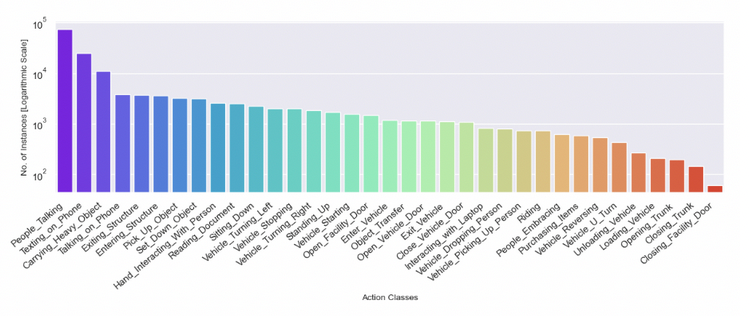
All of our samples are obtained from CCTV cameras mounted at high altitudes, which results in lower resolution of the action regions. MAMA consists of 35 classes, with several of the dataset statistics illustrated in Table 1. MAMA consists of a total of 32726 videos with 25837 videos in the train split, and 6889 videos in the test split. The length of clips in the dataset ranges from 1 sec to 5 sec.
The action-classes in the MAMA dataset capture both human-human ‘indirect’ actions like talking, as well as physical contact such as ‘hand_interacting_with_person’. Furthermore, we also annotate the human-object interactions, such as opening a door, etc. The relative distributions of the activities in the dataset are illustrated below:
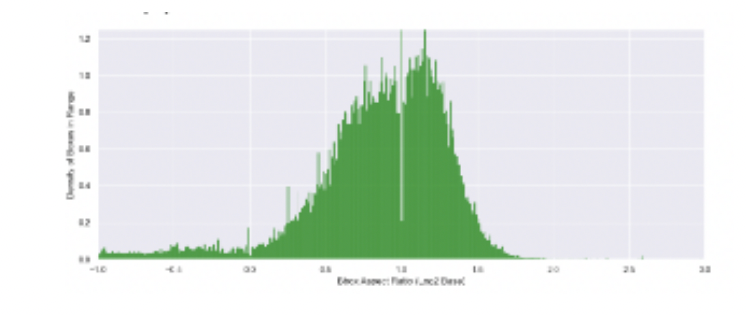
A graph showing the h/w ratios of the bboxes in our dataset w.r.t to frame size has been shown:
Evaluation Protocol and Baseline Model
Our dataset follows the standard evaluation protocol as described in [1]. The participants in the Tiny Actions Detection Challenge have been ranked according to their fMAP, vMAP performance at 0.5 ioU threshold. For accuracy, we estimate the balanced accuracy by averaging the recall of all the 35 classes of the participants predictions. All the participants are requested to submit their predictions on the released test set on the shared Evaluation Server link.
We will also release the code for the baseline model which extends Video CapsuleNet to multi-actor/multi-action detection. Our models can be trained in around 2 days, on a single Nvidia V-100 Card.
Annotation Format
All the annotations are provided in the .json format.
We assume that each .json exists as a dictionary with the following keys:
- action_id: dictionary key corresponding to action occuring in the video.
- actors: list of involved actor ids.
- start_frame: the starting frame of an action. Note that this is w.r.t the read frames of the mp4 file. We follow a 0-based indexing scheme.
- end_frame: the ending frame of an action. Note that this is w.r.t the read frames of the mp4 file. We follow a 0-based indexing scheme.
- detections: a dictionary with frame id as keys.
- frame_ids: a dictionary with actor ids as keys. This signifies all the actors present in a frame, performing a particular action.
- actor_id: [x1,y1,x2,y2] annotates the detection box in a particular frame.
We follow an opencv indexing scheme, eg, (x1,y1) denotes the x coordinate [numpy column], y coordinates [numpy row] of the top-left corner of the bbox. (x2,y2) denotes the bottom right of the bounding box.
Release information
We release zips of train/test splits respectively. Also, separate squashfs containing additional visualizations of all annotated zips can be downloaded off our CRCV server.
Squashfs might help you use our dataset directly without having to extract separate zips.
Contact Informationt
In case of any queries, please contact Dr. Yogesh Singh Rawat (yogesh@crcv.ucf.edu)
If you use this dataset for your research, please cite the following papers:
[1] Modi, Rajat, et al. “Video Action Detection: Analysing Limitations and Challenges.” arxiv preprint arXiv:2204.07892 (2022).
[2] Tirupattur, Praveen, et al. “TinyAction Challenge: Recognizing Real-world Low-resolution Activities in Videos.” arXiv preprint arXiv:2107.11494 (2021).
[3] Demir, Ugur, et al. “TinyVIRAT: Low-resolution Video Action Recognition.” 2020 25th International Conference on Pattern Recognition. IEEE Computer Society, 2021.
Thank you so much for using our dataset.
Happy Activity Detecting 🙂
References
[1] Li, Y., Wang, Z., Wang, L. and Wu, G., 2020, August. Actions as moving points. In European Conference on Computer Vision (pp. 68-84). Springer, Cham.